
Learning how to file business taxes starts with confirming how your business is classified for tax purposes, not just gathering receipts. The right federal return depends on your business structure and tax classification, so a sole proprietor’s filing path may differ from a partnership’s or corporation’s. Once you know which path applies, you can organize the right records and forms.
It’s easy to lose track when financial records are spread across accounts, forms, and folders, or when federal requirements overlap with state and local obligations. A clear process helps you identify what belongs on the return, trace figures to supporting records, and review the details before filing.
This 2026 guide explains how to identify your likely federal filing path, gather and organize financial information, prepare and review your return, and account for state and local requirements. It also covers how consistent bookkeeping and tax preparation support can keep records organized and clarify next steps.
Key Takeaways
- Start by identifying your business’s legal structure and federal tax classification. These help determine which federal return may apply.
- Use the structure-to-return overview to understand common filing paths and the records each may involve.
- Learn how to file business taxes with an orderly process for checking the tax year, business details, income, expenses, and forms.
- Keep filing, paying a balance, and making estimated payments distinct, and account for state and local requirements too.
- Consistent bookkeeping and year-end preparation can make tax filing more organized and help you identify when additional support is useful.
How to file business taxes starts with identifying your filing situation
Business tax filing means reporting income, expenses, and other required details on the applicable tax returns. The right starting point isn’t choosing tax software. First, identify how the business is legally set up and classified for federal tax purposes. That information helps determine which returns and records to review.
Federal business filings can serve different purposes:
- Income tax returns report business income and related tax information. Depending on the structure and tax classification, the activity may be reported on an owner’s return or a separate business return.
- Employment tax returns apply when a business has employment tax responsibilities. These are separate from its income tax return.
- Information returns report certain payments or other details to the IRS and, in some cases, to the people involved.
Bookkeeping supports these filings, but it isn’t the filing itself. Bookkeeping records transactions and organizes financial activity throughout the year. A tax return reports required information to tax authorities. A business return also isn’t always the same as an owner’s personal return: under some tax classifications, business income is reported on an individual return. The filings can be connected, but one doesn’t automatically replace the other.
Which business details shape your federal filing path?
Sole proprietorships, partnerships, and corporations can have different federal income tax filing paths. A sole proprietor generally reports business activity through an individual return. Partnerships generally file an information return, with partners reporting their shares as required. Corporations generally file separate returns, though an S corporation’s income treatment differs from a C corporation’s. Corporate tax provides a general overview of how corporate income tax works.
An LLC label alone doesn’t determine the federal filing path. A single-owner LLC and a multiple-owner LLC may have different default federal classifications, and an LLC may elect a different tax treatment. Ownership, tax elections, and the business’s actual classification all matter. This overview helps you identify what to review, but it doesn’t determine the return required for a particular business.
Federal, state, and local filings are not the same
Federal returns go to the IRS. State and local obligations follow separate rules, and filing a federal return doesn’t necessarily satisfy them. Requirements can depend on the business’s activities and locations, including where it operates and earns income.
A business operating across Alabama, Tennessee, and Georgia may need to consider requirements in more than one state, as well as local obligations. The details vary. Review current filing requirements and deadlines from the relevant state or local tax authority. Identifying the business’s structure, tax classification, and operating locations gives you a clearer foundation for choosing which returns and records to review.
Match your business structure to the return and records it requires
Once you know how your business is classified for federal tax purposes, connect that classification to the return and supporting records it may involve. The forms below are a general guide, not a complete filing determination or individualized tax advice. Ownership, tax elections, business activity, and other details can change the filing path. Review current IRS guidance, including its IRS Business Taxes overview, before preparing a return.
Common business structures and federal return forms
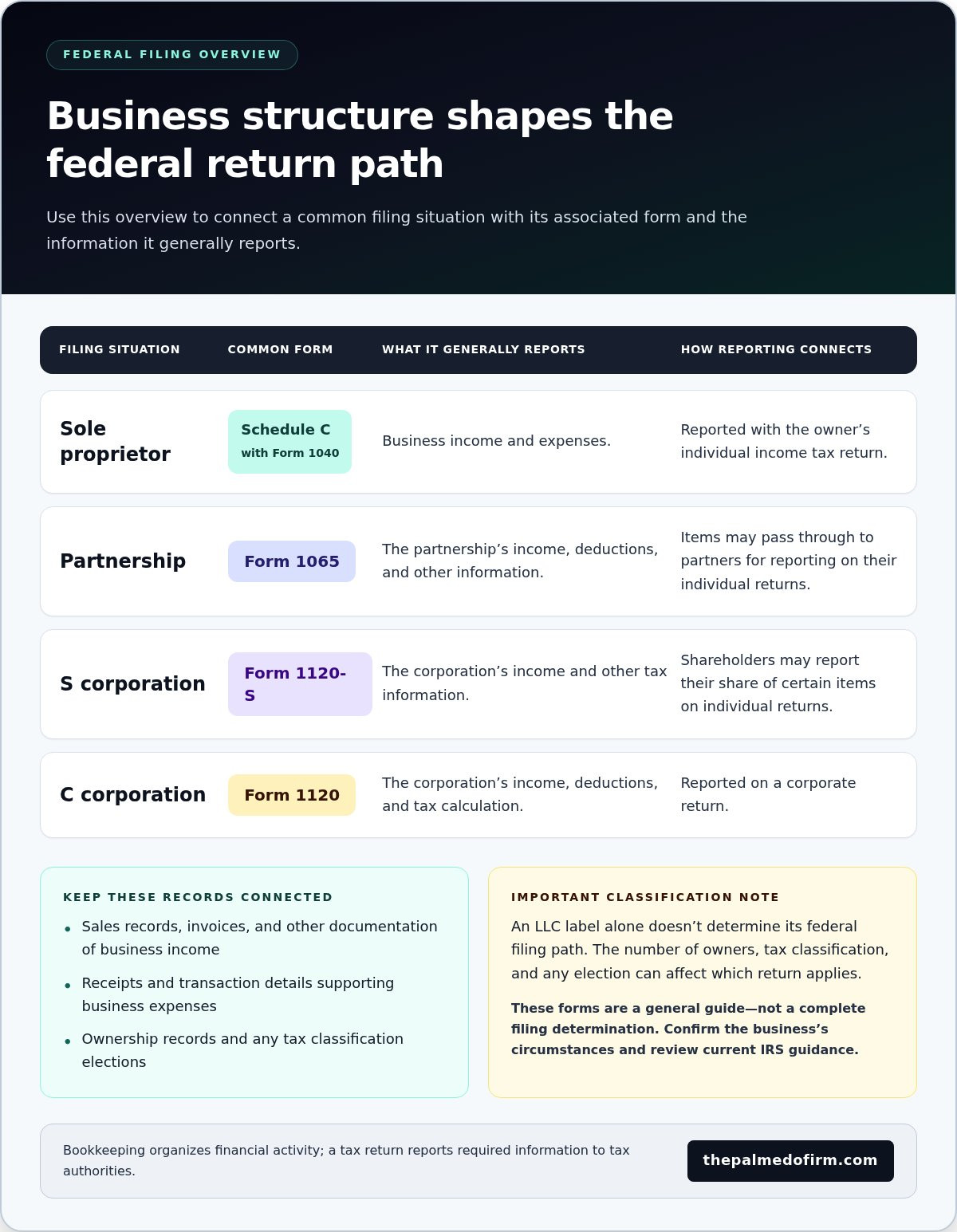
These forms are commonly associated with the structures shown, but a legal label alone doesn’t determine the federal return. An LLC, for example, may be treated differently depending on its owners and tax classification. Use the table to orient your records review, then confirm which forms apply to the business’s specific circumstances.
| Common filing situation | Form often associated | What it generally reports |
|---|---|---|
| Sole proprietor | Schedule C with Form 1040 | Business income and expenses reported with the owner’s individual income tax return. |
| Partnership | Form 1065 | The partnership’s income, deductions, and other information. Items may pass through to partners for reporting on their individual returns. |
| S corporation | Form 1120-S | The corporation’s income and other tax information. Shareholders may report their share of certain items on individual returns. |
| C corporation | Form 1120 | The corporation’s income, deductions, and tax calculation on a corporate return. |
A form name is a starting point, not a complete filing checklist. An LLC with one owner and an LLC with multiple owners may have different default federal tax classifications, and an election can affect the treatment. Two businesses with “LLC” in their names may therefore need different returns. Keep ownership records and any tax classification elections with your year-end materials.
Records that help connect bookkeeping to tax filing
Gather records that show where each reported amount came from. A tax-ready set of records should organize and reconcile the year’s income, expenses, and supporting activity. Useful materials often include:
- Sales records, invoices, and other documentation of business income.
- Receipts and transaction details supporting business expenses.
- Bank and credit card statements, along with explanations for transfers or unusual transactions.
- The prior-year return, which can help with comparisons and continuity.
Reconciled accounts help connect bookkeeping totals to financial statements and bank activity. At year-end, they also make it easier to spot missing documents and unclear transactions before filing. Monthly reconciliations, cash-flow tracking, and year-end preparation keep the work manageable. Business bookkeeping and tax preparation from Patrick Palmedo Accounting can help connect organized records to tax filing.
Prepare and file a business tax return in a clear sequence
A steady workflow helps you find missing information before you submit. If you’re learning how to file business taxes, work from source records through review and submission. The calculations and supporting schedules depend on the business’s tax classification and filing circumstances, so don’t assume every business needs the same forms or steps.
The core sequence is simple: organize the records, complete the applicable return, review the details, submit it, and save proof of filing.
Organize information before completing the return
Before filling in forms, group records so you can trace each total to its source. Reconcile account activity and investigate unclear transactions instead of relying on unreviewed totals. For an item-by-item gathering list, use the separate business tax document checklist article.
- Confirm the tax year. Identify the year the return covers and whether the business uses a calendar or fiscal year. Review records for that same period.
- Check business details. Gather the business’s legal name, address, identification details, ownership information, and tax classification. Compare them with prior filings and current records.
- Sort income and expense records. Group sales and other income separately from expenses. Keep invoices, receipts, statements, and explanations together so you can verify the amounts.
- Review assets and ownership changes. Organize records for business assets and note changes in ownership or tax classification. These details may affect which forms or supporting schedules apply.
- Reconcile before using totals. Compare bookkeeping records with bank and credit card activity. Follow up on unexplained transfers, missing entries, or transactions that may be in the wrong category.
- Identify the applicable forms and schedules. Match the business’s tax classification and circumstances to the required return. Supporting schedules and calculations vary, so use current IRS guidance or tax preparation support to resolve questions.
Review, submit, and keep a filing record
Before submitting, check the return for transposed numbers and outdated details. Confirm that names and identification details match the filing information, reported amounts agree with supporting records, and all applicable forms and schedules are included.
- Review the completed return. Compare income and expense figures with reconciled records. Check calculations, required answers, and information carried over from another form.
- Choose an appropriate submission method. Use an IRS-approved filing method that applies to the specific return. Methods and eligibility can vary, so verify current IRS options before submitting.
- Confirm the submission status. Keep the filing confirmation or other submission record. If the return is rejected or needs correction, retain the notice and follow its instructions.
- Save the complete file. Store a copy of the submitted return, confirmation, supporting schedules, and related records together. An organized file makes future preparation and year-to-year comparisons easier.
Filing is a process, not just a completed form. A clear record trail helps you understand what was reported and provides a practical starting point for the next tax year.
Check payment, deadlines, and state obligations before filing is complete
Preparing and submitting a return is only part of the tax process. You may also need to pay a balance or make estimated payments during the year. These are separate actions, and completing one doesn’t automatically complete the others. As you work through how to file business taxes, track the return, payment, and other filings as distinct items on your tax calendar.
How to check the right deadline and payment requirement
Deadlines can vary by return type, tax year, and business circumstances. Check current IRS guidance for the due date that applies to your federal return, plus any separate payment and estimated-tax dates. Don’t rely on last year’s calendar without confirming it still applies. If you may need an extension, verify what it changes and what it doesn’t. An extension may affect the time to file differently from the time to pay, so review the current rules before acting.
Keep a record of what’s due and what you’ve submitted or paid. For each item, note the tax period, filing or payment type, applicable deadline, and confirmation or receipt. This helps prevent a filed return from being mistaken for a settled balance, or an estimated payment from being mistaken for the annual return. Tax planning can also help you prepare for estimated payments through quarterly estimate calculations and clearer cash-flow planning.
Why a federal return may not finish every filing task
A federal return addresses federal tax reporting. State and local requirements are separate and may depend on where a business operates and what it does there. If your business has activity in more than one location, review obligations across those locations rather than assume the federal filing covers them.
For businesses serving Alabama, Tennessee, and Georgia, review each state separately. Requirements and deadlines may differ, and local rules may also apply. Check current instructions from the relevant state or local tax authority. Confirm which tax periods and activities the rules cover, and keep copies of state or local returns, payment records, and confirmations with the federal file.
A federal tax return reports to the IRS; it doesn’t automatically complete separate state and local filing duties. When closing out a filing year, your final review can include:
- Confirming the federal return was submitted and keeping its confirmation.
- Checking separately whether a balance is due or estimated payments apply.
- Reviewing state and local requirements based on business location and activity.
- Saving payment records and filing confirmations with the related tax-year documents.
Patrick Palmedo Accounting provides tax preparation and planning to help businesses organize filing steps and records. Get support with business tax preparation for your filing needs.
When bookkeeping and tax preparation support can make filing easier
Preparing a return is more difficult when records are incomplete, business activity has changed, or details need to be connected across accounts and forms. Support is useful when organizing the information takes more time than reviewing it, or when you’re unsure how a change affects the filing process. The goal is to bring the facts into order and prepare the applicable return, not promise a particular tax result.
Signs it may help to work with a tax professional
Consider support if the business has income from several sources, recently changed ownership or tax classification, or has records that are missing or difficult to reconcile. Unresolved IRS correspondence can also raise questions about what information is needed and how to respond. A tax professional can review business records, prepare returns, and clarify next steps. That support doesn’t guarantee a specific tax outcome.
Patrick Palmedo Accounting provides business tax preparation, bookkeeping, tax planning, and support with IRS correspondence. Tax planning can include advice on entity structure and deductions. If you’re considering a structural change, keep legal decisions distinct from tax preparation and planning so each question is handled in the right context.
Build a steadier filing process throughout the year
Tax readiness is easier to maintain when recordkeeping happens regularly, not just at year-end. Monthly reconciliations help compare account records with bank activity. Cash-flow tracking and financial reports, such as profit and loss statements, balance sheets, and income statements, give a clearer view of business activity as the year progresses. Organized year-end preparation then gives tax filing a more reliable starting point.
Planning during the year can help, too. Quarterly estimate calculations can help business owners plan for potential payments, but they don’t replace filing the required annual return. Tax planning may also include reviewing deduction strategies and considering how current choices fit longer-term business goals. When bookkeeping and tax preparation are handled as connected parts of the process, it’s easier to spot missing details before year-end.
Patrick Palmedo Accounting helps businesses organize bookkeeping, prepare tax returns, and plan for upcoming tax needs. Businesses in Birmingham, Huntsville, Nashville, Atlanta, Mountain Brook, Homewood, and Gardendale can explore business tax preparation support suited to their filing needs.
Make your next filing season easier to manage
Put one small habit in place now: keep tax-related decisions and records together as the year unfolds. That gives you a clearer starting point when you revisit how to file business taxes and helps turn a once-a-year rush into a steadier routine.
Patrick Palmedo Accounting prepares and files business tax returns and helps businesses maintain bookkeeping throughout the year. Monthly reconciliations and year-end preparation keep financial records organized, while tax planning can include quarterly estimate calculations and multi-year strategies. The aim is practical guidance and clearer next steps, not a promised tax result.
Talk with Patrick Palmedo Accounting about business tax preparation and take a clear next step for your business. With an organized process and support for bookkeeping, tax preparation, and planning, you can approach your next filing with greater confidence.
Frequently Asked Questions
Do I have to file a business tax return if my business had no income?
Maybe. A period with no income doesn’t automatically remove a filing requirement. What you need to file depends on the business’s tax classification, entity type, and circumstances for that tax year. A business with no sales that remained active isn’t necessarily in the same situation as one that formally stopped operating. Check current IRS guidance for your structure and tax year before deciding whether a return is due.
Can I file my business taxes without an EIN?
Possibly, depending on the business and the return. Identification requirements differ by form and filing circumstances. Some sole proprietors may use an individual taxpayer identification method, such as an SSN or, where permitted, an ITIN, rather than an EIN. Don’t assume one identifier works for every return. Review the current IRS instructions for the specific form and follow the rules that apply to your business and filing situation.
What happens if I file my business tax return late?
Possible consequences depend on the return type, whether tax is owed, and how late the filing is. Different returns can follow different rules, so don’t rely on a general penalty estimate or another business’s experience. Check the current IRS instructions for your return promptly. If it’s overdue, organize the relevant records and use tax preparation support to understand the next filing step.
Can I amend a business tax return after filing it?
Often, a filed return can be corrected, but the process depends on the original form and what needs to change. A math error, omitted income, or incorrect business detail may call for different next steps. Compare the filed copy with your supporting records, then check current IRS instructions for that form before submitting a correction. One amendment form does not apply to every business return.
Do I need to file a separate federal return for a single-member LLC?
It depends on the LLC’s federal tax classification and any elections it has made. Some single-member LLCs generally report business activity through the owner’s federal return, while an LLC with a different tax classification may need a separate business return. State registration as an LLC doesn’t, by itself, determine federal tax treatment. Check current IRS guidance for the LLC’s classification and filing circumstances.
Can I file my business taxes before receiving every tax form?
Filing before relevant information arrives can leave a return incomplete or inaccurate. Whether you can proceed depends on the missing form and whether reliable records support the figures it would report. Reconcile your books against invoices and account statements, then follow up on the missing document. Before submitting, check current IRS guidance. If you later find an error, review the form-specific correction process.
Are business tax filings public record?
Federal tax return information is generally protected, but that doesn’t mean every record connected to a business is private. State filings, registrations, and other business documents may be accessible under different rules, which vary by record and jurisdiction. The answer depends on the document and where it was filed. Check the relevant agency’s current guidance for that specific record rather than assuming all business filings have the same status.
What should I do if I cannot pay my business tax balance by the deadline?
Don’t treat difficulty paying as a reason to ignore the return. Filing and paying are separate responsibilities, and the available next steps depend on the return and your circumstances. Review current IRS payment options promptly and consider how to address the balance based on your business’s situation. Don’t assume you qualify for a particular arrangement. A tax professional can help you understand the filing details and organize the information you’ll need.

