
The tax return is only as clear as the records behind it. If you’re unsure which return fits your business or whether your books are ready, small business tax preparation can feel like a lot to sort through. The right filing approach depends on your business structure, the quality of your records, and how much guidance you need.
You don’t need to have every detail figured out before you begin. This guide walks through the main steps in preparing a business return and explains how organized bookkeeping makes them more manageable. You’ll learn how business structure affects filing, which records help clarify your business activity, and how to weigh tax software against professional preparation.
Patrick Palmedo Accounting prepares and files business returns, supported by bookkeeping, account reconciliations, and year-end financial information. Whether you’re getting ready to file or planning ahead, understanding the process can help you choose the support that fits and have a more focused conversation about your return.
Key Takeaways
- Learn what small business tax preparation includes and how it differs from bookkeeping, tax planning, and other business support.
- See how reconciled accounts and clear financial reports make tax figures easier to review.
- Use practical factors such as record quality, business complexity, and confidence to weigh tax software against professional preparation.
- Follow a year-end review to spot questions and organize business information before filing.
- Understand how monthly bookkeeping and year-end reporting support a more orderly tax return process.
What small business tax preparation covers, and what it does not
Tax time is more manageable when you know what preparation involves. The process starts with organizing financial information, reviewing what it shows, and completing the return that applies to the business. The goal is a clear, accurate filing based on the records and the business’s circumstances, not a guaranteed refund or tax result.
Small business tax preparation means reviewing business financial information and using it to complete and file the applicable tax return. A preparer works from the information provided and may ask questions when a figure or transaction needs clarification. Tax preparation can be handled by a business owner using software or with help from a tax professional.
Preparation is related to, but distinct from, other work. Bookkeeping records and organizes transactions. Tax planning looks ahead at decisions that may affect taxes. Payroll involves handling employee pay and related tasks. Legal advice addresses legal questions, while audit representation concerns responding on a taxpayer’s behalf in an audit. These activities have different purposes, although bookkeeping and planning can support a more orderly return process.
What information does a business tax preparer work from?
A preparer needs a useful picture of the business year: its income, expenses, and year-end financial position. Organized records and reports such as a profit and loss statement can help show that picture. The preparer uses these details to complete the return and identify questions that need the owner’s explanation.
Complete, consistent records make business activity easier to review. For example, when account totals have been reconciled and expenses are recorded consistently, it’s easier to trace how reported figures were reached. The exact records needed depend on the business and its activity, so focus on being able to explain the figures rather than assembling a one-size-fits-all packet.
How business structure affects a tax return
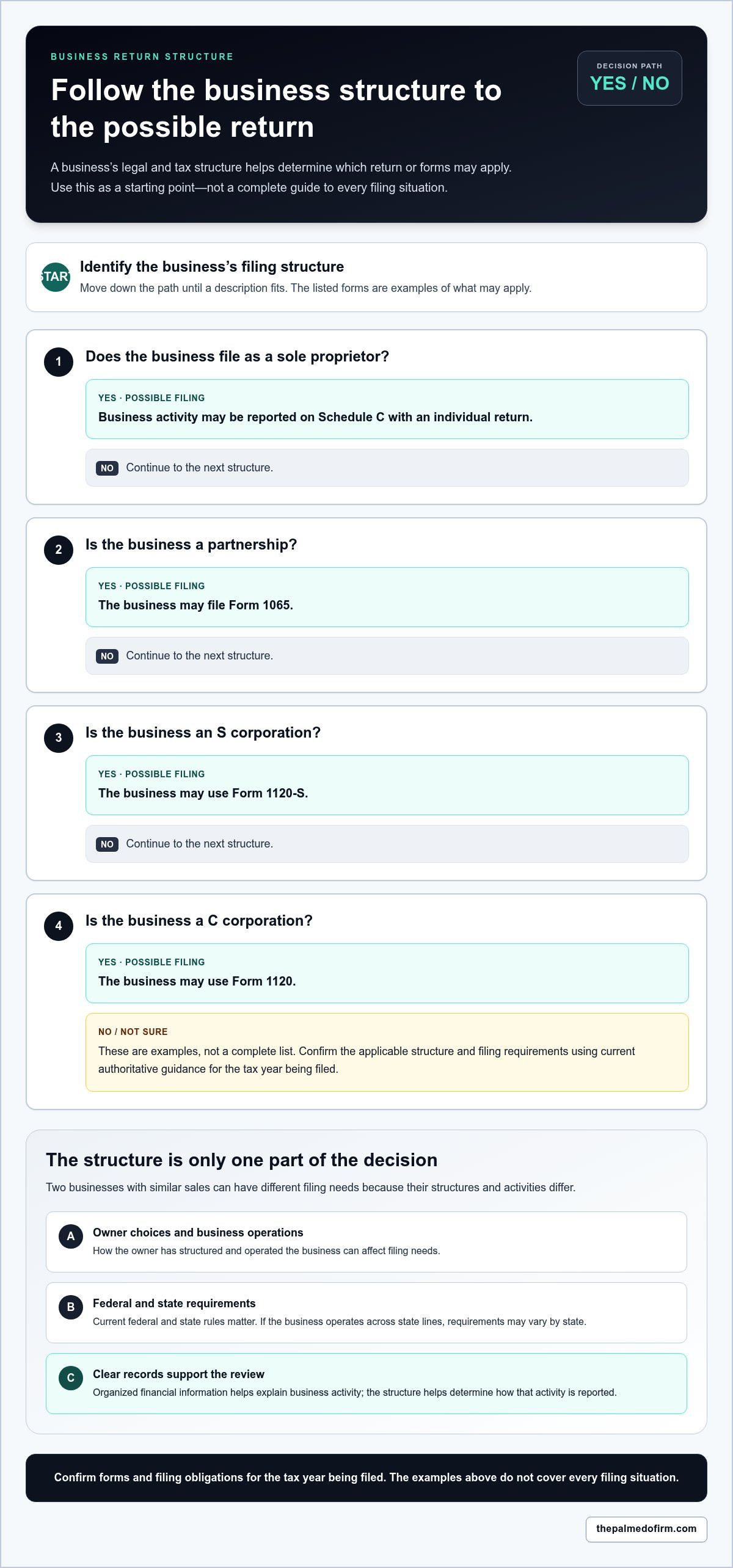
The business’s legal and tax structure helps determine which return or forms may apply. A sole proprietor may report business activity on Schedule C with an individual return. A partnership may file Form 1065, while an S corporation may use Form 1120-S and a C corporation may use Form 1120. These are examples, not a complete guide to every filing situation.
Two businesses with similar sales can have different filing needs because their structures and activities differ. The owner’s choices, how the business operates, and current federal and state rules all matter. If a business operates across state lines, requirements may also vary by state. Use current authoritative guidance for the tax year being filed to confirm forms and filing obligations. Clear records help a preparer understand the activity, while the business’s structure helps determine how that activity is reported.
How clean bookkeeping supports accurate small business tax preparation
Bookkeeping gives tax preparation a more dependable starting point. When accounts are reconciled and reports reflect recorded activity, the preparer can review how the business earned and spent money without first untangling avoidable discrepancies. That makes the year-end review more orderly and can surface questions while there’s still time to clarify them.
Current records help a preparer compare account balances with reported income and expenses, trace figures in financial statements back to transactions, and spot gaps or unusual changes that need the owner’s explanation. This supports a clearer review of the business’s activity, but bookkeeping alone doesn’t determine how every item should be treated on a tax return.
Which financial records help clarify the year?
Reconciled accounts help show whether recorded balances match the activity reflected in financial accounts. A profit and loss statement gives a readable view of income and expenses across the year. Supporting transaction records provide detail when a figure needs review. Together, these records make it easier to follow the path from day-to-day activity to year-end totals.
Keep business and personal spending separate where possible. If one account includes both, identify which transactions belong to the business. For example, a personal purchase recorded alongside business expenses can make an expense category harder to interpret. Separating the activity makes the business picture easier to review. Gather supporting records that relate to your business and filing situation, and flag anything you can’t readily explain.
What happens when records are incomplete?
Missing entries, unreconciled balances, or unclear transactions can lead to follow-up questions. A preparer may need to pause while the owner locates information or explains a transaction. That doesn’t mean the return can’t be prepared, but gaps can slow the review and make it harder to understand how totals were assembled.
Don’t fill a gap with a guess. Note where a figure is estimated, identify missing records, and flag unusual transactions for discussion. A short explanation is more useful than an unsupported number. This gives the preparer a clear place to start and separates what’s known from what still needs attention.
Monthly bookkeeping helps keep account activity organized throughout the year. At year-end, reconciliations, cash-flow tracking, and financial statements provide a consistent base for review. These records don’t replace a tax professional’s judgment about how an item should be reported, but they make the business’s recorded activity easier to understand.
For Birmingham business owners, Patrick Palmedo Accounting provides bookkeeping, financial reporting, and business tax preparation. Monthly reconciliations and year-end financial information can create a clearer starting point for filing. Explore small business bookkeeping and tax preparation to learn about the firm’s services.
DIY software or a tax professional: which preparation approach fits?
There isn’t one right way to file for every small business. The best fit depends on how the business operates, how clear its records are, and how comfortable the owner feels answering tax questions without a live discussion. Software may work for a straightforward business with orderly records. More layered activity or uncertainty about the return may make professional review useful.
Use these factors to compare the options. They’re practical indicators, not a substitute for confirming which forms and rules apply to your business.
| Factor | Software may fit when… | Professional preparation may help when… |
|---|---|---|
| Business complexity | Activity is straightforward, with few changes to explain. | The business has multiple activities, changing income, or questions about its structure. |
| Record quality | Records are organized, consistent, and ready to enter. | Entries, balances, or transactions need closer review before filing. |
| Owner confidence | You’re comfortable interpreting prompts and entering business information. | You want help understanding how the business’s activity fits the return. |
| Need for discussion | You can resolve questions through the software’s guidance and current IRS resources. | You have questions that benefit from a conversation and a review of your circumstances. |
A business’s size alone doesn’t determine its filing needs. Two small businesses may have different structures, forms, and reporting considerations. Software also varies in the forms and situations it supports, so check that the tool fits your business return. For questions about filing obligations, use current IRS guidance or discuss the issue with a tax professional.
When may self-filing be a practical fit?
Self-filing may suit an owner whose business activity is relatively straightforward, whose records are in good order, and who feels comfortable following software prompts. Enter information carefully and make sure you understand what the software is asking. If the business has activity the software doesn’t support, or a prompt raises a question you can’t resolve, pause rather than guess.
When can professional preparation help?
Professional preparation may be useful when income changes from year to year, the business has several activities, its structure raises filing questions, or its records need closer review. A tax preparer can review the information, ask about unclear items, and prepare the applicable return. That review gives you a chance to explain the facts behind the figures before filing.
Keep the scope clear. Return preparation focuses on reviewing information and completing the applicable filing. Tax planning considers decisions that may affect taxes over time, while help with IRS correspondence addresses notices or other communications. Neither preparation nor correspondence help is the same as audit representation. Patrick Palmedo Accounting provides business tax preparation and tax planning. For support with a business return, professional small business tax preparation brings records and filing questions into one focused review.
Prepare for business tax filing with a simple year-end review
A year-end review can help you hand over clearer information for small business tax preparation. It doesn’t replace a full filing walkthrough. Instead, it gives you a chance to close out the books, spot questions, and make sure the preparer has a useful picture of the business before work on the return begins.
Use this sequence as a starting point:
- Close the records. Bring the year’s recorded activity up to date and finish reconciling business accounts.
- Review the reports. Look over year-end financial statements, including the profit and loss statement, for totals that seem incomplete or out of place.
- Note unusual items. Write down major changes, unfamiliar transactions, estimates, or gaps that may need explanation.
- Clarify the business structure. Confirm how the business operated and whether its structure or activities changed during the year.
- Prepare to file. Share organized information and open questions with the person preparing the return, or use them to guide your software entries.
Address record questions before return preparation begins. That helps the preparer work from explained figures instead of pausing to untangle unclear activity.
Review business activity before the return is prepared
Compare year-end financial reports with the account records they summarize. If a report shows a change that doesn’t match what you remember, look for a missing entry, a timing difference, or another explanation. The goal isn’t to decide tax treatment on your own. It’s to make the reported activity understandable and identify questions that need review.
Note significant changes, such as a new source of business income or a large change in spending, along with transactions that don’t fit the usual pattern. If a record is incomplete, say what’s missing rather than filling the gap with a guess. Keep the explanation brief and factual. Whether an item qualifies for a deduction is a separate question for return preparation, and shouldn’t be assumed from the bookkeeping entry alone.
Account for state and location differences
Business tax obligations can depend on the entity, the activity, where the business operates, and other facts. A business with activity in more than one state may need to consider different state rules. Don’t assume that a filing approach used in Alabama automatically applies in Tennessee or Georgia. For a 2026 return, verify current requirements with the relevant state revenue authorities and the IRS. Forms, deadlines, and rules can change, so use guidance for the tax year being filed.
Patrick Palmedo Accounting serves Birmingham and other communities across Alabama, Tennessee, and Georgia, including Huntsville, Nashville, Atlanta, Mountain Brook, Homewood, and Gardendale. The firm prepares and files business returns, supported by bookkeeping and year-end financial information. To review your records and prepare for filing, get help with business tax preparation.
Small business tax preparation with Patrick Palmedo Accounting
Preparing a business return is easier when the financial information behind it is organized and clear. Patrick Palmedo Accounting prepares and files business tax returns, using the available information to understand the business’s activity and complete the applicable return. Questions about figures or transactions can be discussed during the preparation process, giving owners a clearer sense of what the return reflects.
Tax preparation can also sit alongside other financial support. The firm provides tax planning, entity-structure advice, financial reporting, bookkeeping, and help with IRS correspondence and tax notices. Each service has a different role. Return preparation focuses on completing and filing the applicable return; planning and reporting help owners understand and consider business finances beyond that filing.
A connected approach to business records and returns
Recurring bookkeeping gives year-end preparation a more consistent starting point. Monthly account reconciliations help keep recorded balances in order, while cash-flow tracking gives owners a clearer view of money moving through the business. When activity is organized over time, it can be easier to review the year than to sort through everything at filing time.
Year-end financial statements add context. A profit and loss statement summarizes income and expenses over a period. A balance sheet shows the business’s financial position at a point in time. Together, these reports help a preparer understand the figures and follow up on activity that needs explanation. They don’t determine the tax treatment of every item, but they make the records easier to review.
This is where bookkeeping and tax preparation connect without becoming the same task. Bookkeeping organizes recorded activity. Tax preparation uses business information to complete the return under the rules that apply to the business. Owners looking for more detail on routine recordkeeping can explore the bookkeeping guidance elsewhere in this article.
Local tax preparation support for business owners
Patrick Palmedo Accounting serves business owners in Birmingham, Huntsville, Nashville, Atlanta, Mountain Brook, Homewood, and Gardendale. The firm works with businesses in Alabama, Tennessee, and Georgia, where state filing rules may differ. Requirements depend on the business’s facts and current rules, so each return should reflect the circumstances that apply.
The aim is a focused process: organized financial information, clear communication about questions, and preparation and filing of the business return. The firm’s bookkeeping, tax planning, and financial reporting can support that process, while its IRS correspondence help addresses tax notices. This does not include audit representation, and no particular refund or tax outcome can be promised.
If you’re preparing for a business filing and would like to learn more about small business tax preparation with Patrick Palmedo Accounting, explore the firm’s business tax preparation service.
Make your next filing step a clear one
Tax readiness doesn’t have to become a once-a-year scramble. Set a simple checkpoint for your business, such as after a major change in activity or structure, and note questions while the details are still fresh. That gives you a practical starting point when it’s time to handle small business tax preparation.
You don’t need to solve every tax question before seeking help. Bring forward what you know, identify what feels uncertain, and use the discussion to understand the next steps for your return. A clear conversation can help turn uncertainty into a workable plan.
Patrick Palmedo Accounting prepares and files business tax returns, with related support in bookkeeping, tax planning, and financial reporting. Learn about small business tax preparation with Patrick Palmedo Accounting and take the next step for your business.
Frequently Asked Questions
What does small business tax preparation include?
Small business tax preparation includes reviewing business income and expense information, identifying questions that affect reporting, completing applicable tax forms, and filing the return. The work depends on the business’s structure and activity. For example, a change in ownership or a new line of business may affect what information needs review. Keep records available and explain unusual figures rather than assuming every transaction is treated the same way.
Can I prepare my small business taxes myself?
Yes. You can prepare your own return if you understand the business’s records and the software supports your filing situation. Self-filing may feel manageable when activity is straightforward and you’re comfortable answering the software’s questions. If a prompt doesn’t fit your circumstances, don’t force an answer. Review current IRS guidance or get professional help with questions you can’t resolve confidently.
Do I need a separate tax return for my small business?
Not always. Some sole proprietors report business activity on an individual return, while partnerships and corporations generally have business filing requirements tied to their tax classification. The details depend on the business’s structure and current rules. An owner’s individual return may also need information from a business filing. Confirm the forms and obligations that apply to your situation before deciding that no separate return is needed.
When should I start preparing my small business tax return?
Start before filing deadlines are close. Reviewing records throughout the year and setting aside time for a year-end review gives you more room to find missing information, explain unusual activity, and address return questions. If your business has changing operations or more than one filing obligation, starting sooner can help you identify what needs attention without rushing.
What if my business did not make a profit?
A business with no profit may still have tax filing or reporting obligations. A loss doesn’t automatically mean there’s nothing to file, and its treatment can depend on the business structure, activity, and other facts. Keep records that show how the result was calculated, including income and expenses. Check current filing guidance or have a preparer review the situation before deciding whether a return is required.
Does small business tax preparation include tax planning?
Tax preparation and tax planning are related but separate. Preparation focuses on completing and filing the return for the tax year; planning looks ahead at decisions that may affect future taxes. Patrick Palmedo Accounting offers both services, including planning around quarterly estimates and entity structure. The firm serves business owners in Birmingham, Huntsville, Nashville, Atlanta, Mountain Brook, Homewood, and Gardendale, with state rules depending on each business’s circumstances. Contact Patrick Palmedo Accounting about small business tax preparation.

