
What if bookkeeping could do more than keep receipts in order? Bookkeeping services for small business can turn everyday transactions into a clearer picture of cash flow and business performance. When receipts, invoices, and account records pile up, it’s easy to lose track of what the numbers are saying. That can make routine decisions harder and tax-time preparation more stressful.
You don’t need a complicated system to get more control. Consistent records help you track money coming in and going out, review how the business is doing, and prepare for year-end with fewer loose ends. The key is making bookkeeping a regular process, not a last-minute catch-up task.
This practical 2026 guide explains what routine bookkeeping covers, how to keep records useful, and how monthly reconciliations, cash-flow monitoring, and financial reports support better visibility. You’ll also learn how to choose a manageable approach, whether you handle records yourself or get ongoing professional support. The goal is steady, usable financial information that makes day-to-day management more straightforward.
Key Takeaways
- Think of bookkeeping as a repeatable process that turns business activity into records you can use, not just a pile of transactions.
- Keep supporting documents complete and categorize transactions consistently so records can be matched to account activity.
- Choose between handling bookkeeping yourself, using software, or getting professional support based on your time, transaction complexity, and reporting needs.
- Review records regularly to spot cash-flow timing questions and keep year-end preparation organized.
- Bookkeeping services for small business can include monthly reconciliations, cash-flow tracking, financial reports, and year-end preparation.
What bookkeeping services for small business include and why they matter
Bookkeeping is the ongoing work of recording and organizing a business’s financial activity. In practical terms, bookkeeping organizes financial activity so owners can understand what happened. That means more than entering numbers. Each transaction needs a clear place in the records and, where possible, supporting documents such as a receipt, invoice, or payment confirmation. For a foundational overview, see What is bookkeeping?
Reliable records help owners see what money came in, what went out, and how the business is performing over time. This context can inform decisions, such as whether expenses are rising or customer payments are keeping pace with bills. It also gives year-end preparation an orderly starting point instead of leaving months of activity to sort through at once.
Bookkeeping is one part of a wider financial picture. It keeps transaction records current and organized. Accounting can use those records to prepare and interpret reports, while tax planning considers how business activity may affect tax decisions. These activities connect, but they serve different purposes.
Which routine tasks are part of small-business bookkeeping?
Routine work includes categorizing transactions consistently and keeping related records together. For example, a customer invoice should be easy to connect to the payment received. Account reconciliation means comparing recorded transactions with bank or credit account activity to confirm the records align. Cash-flow monitoring tracks money moving into and out of the business.
- Record income and business expenses in consistent categories.
- Keep receipts, invoices, and other supporting records organized with the related activity.
- Review account activity and track incoming and outgoing cash.
These steps turn scattered paperwork into a usable record of business activity. The routine can vary depending on how a business receives payments, pays expenses, and manages its accounts.
What do organized business records help an owner see?
Consistent records make it easier to review patterns instead of relying on memory or a current bank balance alone. Reports can summarize activity, but they’re only useful when the underlying transactions have been recorded and maintained. Missing income or expenses can leave a report incomplete.
For example, an owner can review customer receipts alongside expenses to compare money received with costs paid during the same period. That review may raise questions worth investigating, such as whether customer payments are arriving after major bills are due. The records don’t make the decision for the owner. They provide a clearer basis for it.
Bookkeeping services for small business can include recurring account reconciliations, cash-flow tracking, profit and loss statements, and year-end preparation. Regular attention keeps reports connected to day-to-day activity, giving owners clearer information to review and a more organized set of records when year-end work begins.
How the small-business bookkeeping cycle turns transactions into usable records
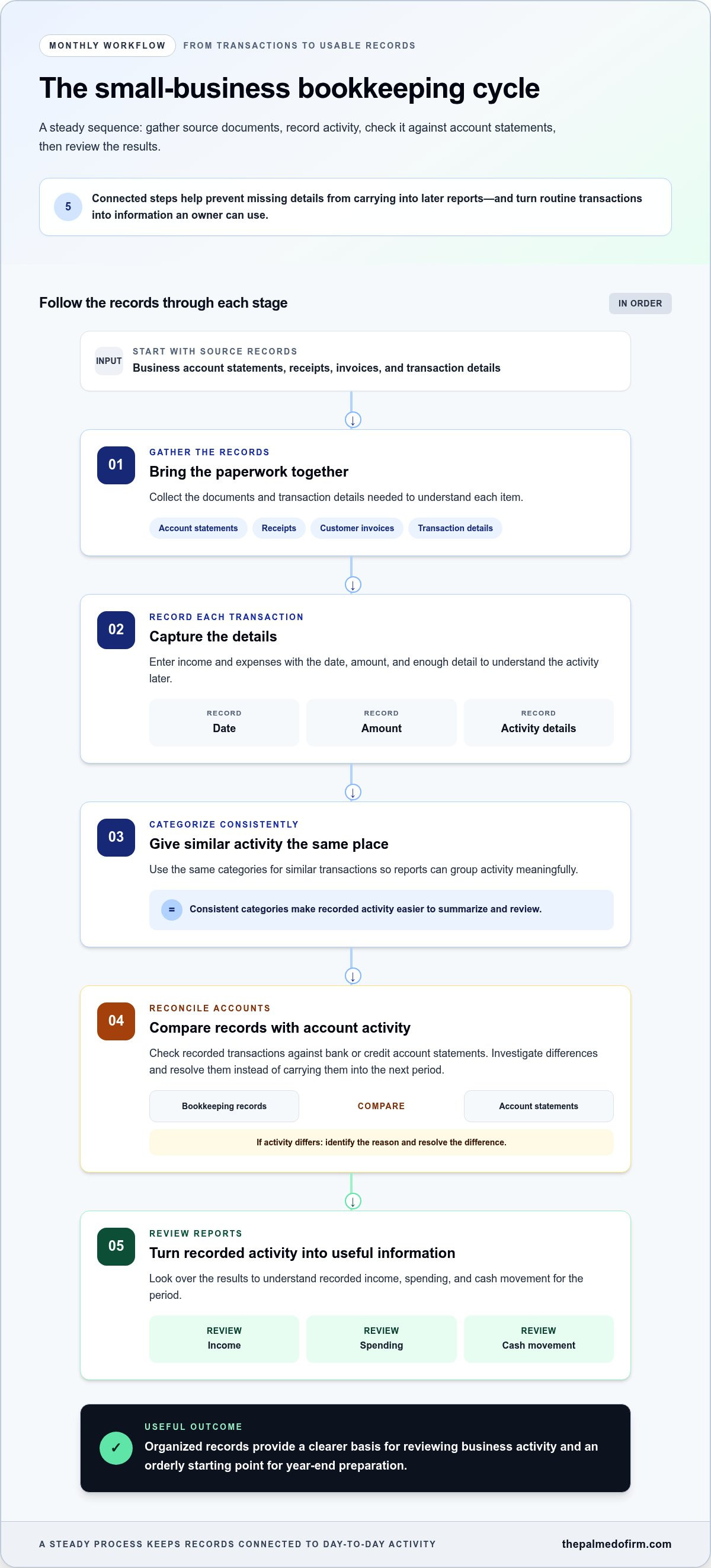
Bookkeeping works best as a steady cycle. Gather source documents, record activity, check it against account statements, then review the results. Each step builds on the last. A consistent process helps prevent missing details from carrying into later reports and shows how routine transactions become useful financial information.
Practical small-business accounting guidance connects bookkeeping with financial reporting and tax preparation. Here’s a simple monthly workflow:
- Gather the records. Collect business account statements, receipts, invoices, and details about each transaction.
- Record each transaction. Enter income and expenses with the date, amount, and enough detail to understand the activity later.
- Categorize consistently. Use the same categories for similar transactions so reports can group activity meaningfully.
- Reconcile accounts. Compare recorded activity with account statements, then investigate differences.
- Review reports. Look over the results to understand recorded income, spending, and cash movement for the period.
Regular recordkeeping creates an organized starting point, reconciliation checks it against account activity, and review turns the results into information an owner can use.
What information should owners gather for recurring bookkeeping?
Start with business bank and credit account statements, receipts, customer invoices, and transaction details that explain what a payment was for. Keep each document connected to its transaction, whether you organize records by month, account, or category. Complete source records make monthly work more dependable. Organization supports accuracy, but it doesn’t replace reviewing records and reports for gaps or unusual activity.
How does monthly reconciliation fit into the cycle?
Reconciliation means comparing bookkeeping transactions with activity shown on account statements. If a payment appears in one place but not the other, identify the reason and resolve the difference instead of carrying it into the next period. Regular review can make discrepancies easier to trace while transaction details are still available. This is the purpose of monthly account reconciliations as part of ongoing bookkeeping support.
A difference doesn’t always mean a mistake. A transaction may have been recorded for the wrong amount, entered twice, or assigned to the wrong account. Identify and correct the mismatch before relying on the records. With bookkeeping services for small business, recurring reconciliation and report review help keep financial information current and year-end records organized.
DIY, bookkeeping software, or a professional service: how to compare approaches
There isn’t one right way to manage every business’s books. The best fit depends on how much time you can set aside, how involved your transactions are, and how much support you need to keep records consistent and reports clear. Use this comparison as a starting point, not a fixed rule.
| Approach | May suit you when | What to keep in mind |
|---|---|---|
| Owner-managed | Activity is manageable, and you can keep records current. | You handle the ongoing data entry, organization, and review. |
| Software-supported | You want a tool to help record and organize transactions. | You still need to check categories, account activity, and reports. |
| Professional support | Your workload or reporting needs make consistent bookkeeping difficult to maintain alone. | You still provide complete business records and details. |
Software can make routine recordkeeping more organized, but it doesn’t replace regular review. A transaction may be entered in the wrong category, or supporting details may be missing. Check for these issues before relying on a report. The tool supports the process; it doesn’t determine whether the information is complete or makes sense for your business.
When might an owner manage bookkeeping without ongoing support?
Owner-managed bookkeeping can work when transactions are straightforward and there’s enough time to maintain the records. Set aside a regular block of time to collect documents, enter activity, check account records, and review what the numbers show. If those tasks keep slipping or take time away from essential business work, reassess your approach. Doing it yourself still requires a reliable routine and accurate records.
When can professional bookkeeping support be useful?
Consider ongoing help if records regularly fall behind, cash flow feels unclear, or year-end preparation becomes a scramble. Recurring bookkeeping can include monthly reconciliations and consistent financial reporting, giving you organized information to review. You still need to share receipts, invoices, statements, and transaction context so the records reflect what happened.
Think about the work involved, not just the tool. If your activity is manageable and you can keep a routine, owner-led records may be enough. If software helps you stay organized but you need help reviewing the books, a supported approach may fit. For more involved records or a recurring need for clearer reporting, bookkeeping services for small business can provide practical support while keeping you informed about your finances.
How to keep bookkeeping useful for cash flow, reports, and year-end preparation
Records become more useful when you return to them regularly. A short monthly routine can help you notice missing information, understand cash movement, and keep financial reports grounded in current records. The time required may vary from month to month. The goal is to make review a normal part of managing the business, not a task saved for year-end.
Use this recurring checklist to keep the process manageable:
- Gather business statements, receipts, invoices, and transaction details for the period.
- Organize documents so each item can be connected to the related transaction.
- Review recorded activity and resolve missing details or account differences.
- Check cash coming in and going out, including the timing of expected payments and expenses.
- Look over current financial reports and note questions to follow up on.
Cash-flow monitoring can reveal timing issues that a profit-and-loss total alone may not show. For example, sales may be recorded, but customer payments might arrive after rent or supplier bills are due. Watching when money comes in and goes out helps owners consider whether enough cash will be available for near-term needs. A separate guide to small-business cash flow can explore this topic in more detail.
What should owners review in their financial reports?
A profit and loss statement gives a high-level view of income and expenses over a period. An income statement serves a similar reporting purpose, while a balance sheet shows the business’s financial position at a particular point in time. An income statement is a snapshot of performance over a period; a balance sheet is a snapshot of financial position at a point in time. Review patterns across periods and follow up on unexpected changes instead of drawing a conclusion from one figure alone. A focused guide to profit and loss statements can help explain how to read that report.
Ask practical questions as you review: Are expenses changing? Are payments arriving as expected? Does the report include the activity you expected for the period? The records behind the reports matter. Missing transactions or supporting details can leave important questions unanswered.
How can consistent records make year-end preparation smoother?
Complete monthly records give year-end preparation a more orderly foundation. Receipts and invoices are easier to match to transactions while the details are still familiar. Account differences can be investigated as they arise instead of becoming a longer list of questions later. Missing receipts or unresolved differences may require extra follow-up and make it harder to understand a transaction.
Keeping records current doesn’t remove every year-end question, but it can make supporting information easier to review. Bookkeeping services for small business can include recurring financial reporting and year-end preparation, helping owners keep records useful throughout the year. Explore bookkeeping support for help maintaining clear, consistent business records.
What small-business bookkeeping support from Patrick Palmedo Accounting looks like
Steady bookkeeping support gives business owners a clearer view of recorded activity as the year progresses. Patrick Palmedo Accounting provides small-business bookkeeping that brings together monthly account reconciliations, cash-flow monitoring, financial reporting, and year-end preparation. The focus is practical: keep business records organized and make financial information easier to review.
What bookkeeping and reporting support can business owners expect?
Monthly account reconciliations compare recorded transactions with account activity and help identify differences that need attention. Cash-flow tracking follows money moving into and out of the business. Together, these recurring tasks keep the books connected to activity in business accounts.
Bookkeeping support also includes profit and loss statements and year-end preparation. Financial reporting can include balance sheets and income statements, giving owners different views of business finances. An income statement shows income and expenses over a period, while a balance sheet presents financial position at a point in time. Reviewing both can help an owner ask more informed questions about business activity.
Bookkeeping records also support related tax work, though the services have distinct roles. Patrick Palmedo Accounting provides business tax preparation and tax planning, including quarterly estimated-tax calculations. Organized records give those services a clearer starting point, while tax preparation and planning focus on tax reporting and decisions.
- Monthly account reconciliations help compare records with account activity.
- Cash-flow tracking supports visibility into money moving through the business.
- Financial reports include profit and loss statements, balance sheets, and income statements.
- Year-end preparation helps bring the year’s records together for review.
How can local businesses take the next step?
Patrick Palmedo Accounting serves businesses in Birmingham, Huntsville, Nashville, and Atlanta, as well as Mountain Brook, Homewood, and Gardendale. If records are becoming difficult to keep current or reports leave you with unanswered questions, ongoing bookkeeping can provide a more dependable routine. You still play an important part by sharing complete records and relevant transaction details.
For business owners looking for clearer, steadier financial records, explore bookkeeping support for your small business. A consistent bookkeeping process can make monthly reviews and year-end preparation more manageable.
Make your next bookkeeping step manageable
A steadier financial routine doesn’t have to begin with a complete overhaul. Choose one practical step you can maintain, such as setting aside time to organize recent business records or review your financial information. Small, consistent actions make it easier to spot what needs attention and decide what support would help.
If keeping up with the books competes with running your business, consider whether bookkeeping services for small business could make the routine easier to sustain. The right support should help you feel more informed and involved, not removed from your own finances. You can stay part of the process while getting help keeping records in order.
Explore bookkeeping support for your small business and take a measured next step toward clearer financial records. A manageable process can bring more confidence to the way you run your business.
Frequently Asked Questions
How much do bookkeeping services for a small business cost?
The cost depends on the amount and complexity of the work, so there isn’t one price that fits every business. Transaction volume, the number of accounts, how current the records are, and the reporting needed can all affect the scope. Rather than choosing by price alone, consider how much time you spend maintaining records and what information you need to manage the business. Patrick Palmedo Accounting provides bookkeeping support for small businesses.
Can I do bookkeeping for my small business without accounting software?
Yes. You can use a spreadsheet or another organized recordkeeping method if it helps you record each transaction and keep supporting documents accessible. Include the date, amount, purpose, and category for each item, then compare your records with account statements regularly. Keep a backup of your files and use the same categories over time. Software can make organization easier, but careful review still matters.
Is bookkeeping worth it for a small business with only a few transactions?
It can be useful even when activity is limited. Recording transactions as they happen helps you avoid relying on memory later and gives you a clearer account of business income and spending. Even a few customer payments and supply purchases can affect available cash and year-end records. If you manage the books yourself, a simple recurring routine may be enough to keep information organized.
When should a new small business start bookkeeping?
Start when the business begins having financial activity, rather than waiting until the first busy period or year-end. Record early expenses and income as they occur, and keep the related receipts or invoices. This creates a useful history from the start and makes it easier to distinguish business activity from personal spending. A brief regular review can help you catch missing details while they’re still easy to remember.
Can bookkeeping services help with quarterly estimated taxes?
Yes. Organized bookkeeping records can help inform quarterly estimated-tax calculations by giving a clearer view of business income and expenses. Patrick Palmedo Accounting offers tax planning that includes quarterly estimated-tax calculations. If income changes during the year, current records can help bring that change into view for review. Bookkeeping supports the planning process, but the estimate should reflect the business’s circumstances rather than rely on an old figure.
Do bookkeeping services prepare business tax returns?
Bookkeeping and tax preparation are related, but they are separate tasks. Bookkeeping organizes business activity, while tax preparation uses financial information to prepare the business return. Patrick Palmedo Accounting provides business tax preparation as well as bookkeeping support for businesses in Birmingham, Huntsville, Nashville, Atlanta, Mountain Brook, Homewood, and Gardendale. Keeping records orderly gives tax preparation a more useful starting point and makes supporting details easier to locate.
What is the difference between a profit and loss statement and a balance sheet?
A profit and loss statement summarizes income and expenses over a chosen period, such as a month or year. A balance sheet shows the business’s financial position at a particular point in time, including what it owns and owes. For example, the income statement can help you review whether expenses rose during a quarter, while the balance sheet can show outstanding amounts and available assets at the report date. Together, they offer different views of the business.

