
A tax return can show what your business owes, but it can’t change decisions made months earlier. Business tax planning gives you time to review income, expenses, purchases, and estimated payments while there’s still room to make informed choices. Waiting until filing season can leave you sorting through records under pressure and wondering whether you missed a useful step.
If you’re unsure which business decisions affect your tax bill, or how to keep records useful beyond filing, you’re not alone. Tax planning isn’t the same as preparing and filing a return. It’s an ongoing process that uses current financial information to help you anticipate obligations and consider options throughout the year.
This guide explains what year-round planning involves and which financial details to review, including income, expenses, cash flow, and business changes. You’ll also learn how organized bookkeeping and clear reports can support decisions, when to revisit estimated taxes, and how to build a practical routine. The goal is a clearer tax picture and fewer last-minute surprises, with choices grounded in accurate records and current rules.
Key Takeaways
- Business tax planning looks ahead at the tax effects of business decisions, while tax preparation focuses on reporting the results.
- Use current bookkeeping and financial reports to spot changes in income, expenses, and cash flow that may shape your planning.
- Assess deductions, credits, entity structure, and income timing based on eligibility, documentation, and business fit, not as automatic tax-saving moves.
- Build a steady review routine: maintain records, review results, note changes, and seek advice when decisions could affect your tax picture.
- Organized records make planning conversations more useful, including discussions about estimated taxes, deductions, entity structure, and longer-term goals.
What Business Tax Planning Means for a Small Business
Business tax planning is the ongoing process of reviewing your financial position and considering the tax effects of business decisions before you make them. It can help you understand what a choice may mean for your tax picture, but it can’t promise a particular result or remove the need to follow applicable rules.
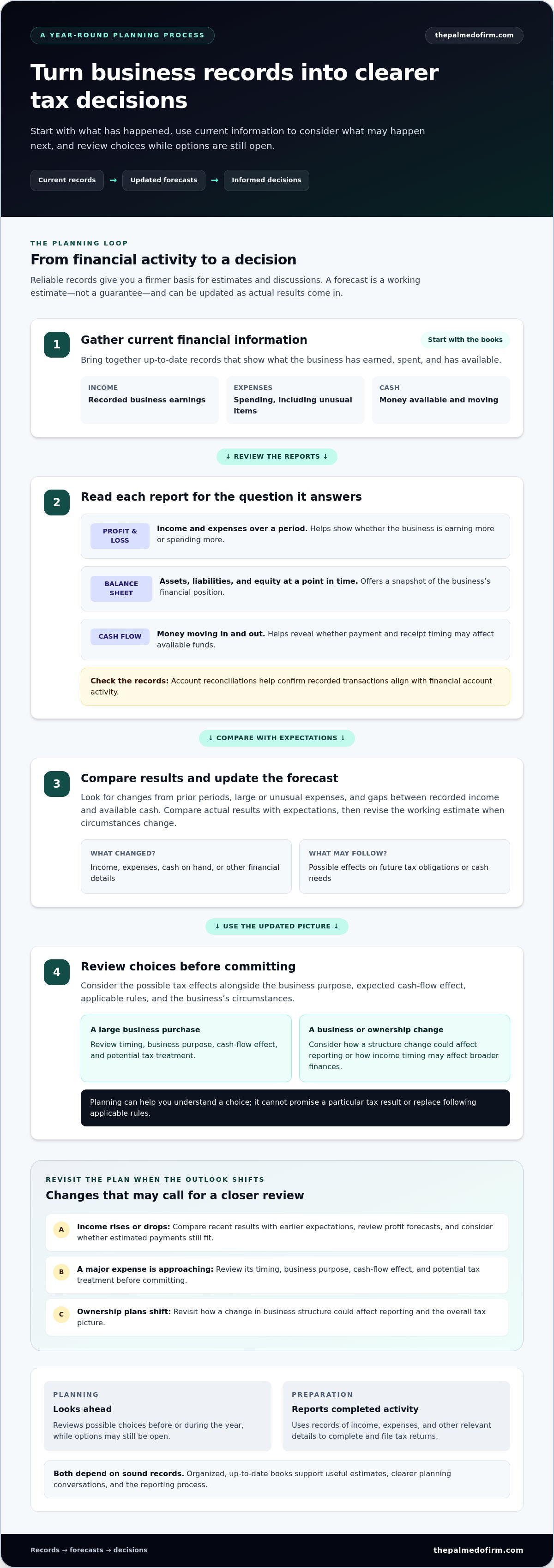
Tax planning looks ahead at possible decisions; tax-return preparation reports completed activity and files the required returns. That distinction matters. A return records what happened during the year. Planning gives you a chance to consider the tax impact of choices while options are still open. For example, before making a large business purchase, you can review its timing, business purpose, expected cash-flow effect, and potential tax treatment. You can also consider how a change in ownership structure could affect reporting or how shifting income may affect your broader finances. The right answer depends on the business and its circumstances.
Responsible planning works within tax rules and relies on accurate information. It isn’t a way to hide income or misstate expenses. For general background on how the terms are used, the Tax avoidance article discusses the distinction between tax avoidance and tax evasion. In practice, business tax planning should focus on understanding applicable rules, documenting decisions, and weighing tax effects alongside the business’s needs.
How Is Tax Planning Different from Tax Preparation?
Preparation happens after financial activity takes place. It uses records of income, expenses, and other relevant details to complete and file tax returns. Planning happens before or during the year. It reviews possible choices and estimates their potential effects, so an owner can make a more informed decision before committing.
Both rely on sound records. Up-to-date books make it easier to see what the business has earned and spent, while clear supporting documents help explain the figures during preparation. If records are incomplete or out of date, it’s harder to make useful estimates or compare options. Keeping accounts organized throughout the year supports clearer planning and a more straightforward reporting process.
Which Small Businesses Can Benefit from Planning?
Sole proprietors, partnerships, and incorporated businesses can all have tax questions worth considering. Their income may be reported differently, and a decision that makes sense for one structure may not suit another. The business owner’s broader circumstances can matter, too.
Size alone doesn’t determine whether planning is useful. A small business may face meaningful choices when income changes, a major expense is approaching, or ownership plans shift. Review decisions that could affect taxes before they’re final, using current financial information and advice suited to the business’s structure and situation. A steady process can help owners spot questions earlier without assuming every decision will produce tax savings.
How Business Tax Planning Connects Records, Forecasts, and Decisions
Useful business tax planning starts with a clear view of what has already happened, then uses that information to consider what may happen next. Current records show income, expenses, cash on hand, and other financial details. Forecasts help estimate how upcoming changes could affect those figures. Together, they give owners a firmer basis for weighing tax-related decisions before acting.
Reliable financial records help owners make better-informed tax decisions by showing what the business can support and what may need a closer review. A forecast is not a guarantee. It is a working estimate that can be updated as actual results come in. If revenue changes from month to month, for example, compare actual results with expectations and update the forecast. That can help identify questions about future tax obligations or cash needs.
What Financial Information Helps Guide Tax Planning?
Different reports answer different questions. A profit and loss statement summarizes income and expenses over a period, helping owners understand whether the business is earning more or spending more. A balance sheet shows assets, liabilities, and equity at a point in time, offering a snapshot of the business’s financial position. Cash-flow information tracks money moving in and out, helping reveal whether the timing of payments and receipts may affect available funds.
Account reconciliations help check that recorded transactions align with financial account activity. This supports confidence in the figures used for estimates and planning discussions. When reviewing reports, look for changes from prior periods, large or unusual expenses, and gaps between recorded income and available cash. Owners who want a closer look at how organized records support business decisions can use this small business bookkeeping guide.
How Can Business Changes Affect the Planning Conversation?
A planning review makes sense when the business’s outlook shifts. It doesn’t mean a particular tax outcome will follow. It means there may be new information to consider alongside current records and applicable rules.
- Changing income: A rise or drop in sales can affect profit forecasts and the amount an owner may need to set aside. Compare recent results with earlier expectations, then review whether estimated payments still fit.
- A major purchase: Before committing to equipment or another large expense, consider its timing, business purpose, cash-flow impact, and tax treatment. The purchase itself doesn’t guarantee a deduction or a specific tax result.
- Hiring plans: Adding employees can change the business’s costs and financial outlook. Review the expected expense and its effect on cash flow, then consider relevant tax implications under current rules.
- A structure or ownership change: A proposed change can affect how business income is reported. Review the potential tax effects before finalizing the decision, based on the business’s circumstances.
Make these reviews part of the year, not a reaction to filing season. Patrick Palmedo Accounting’s business tax planning support helps owners connect financial reports with estimates and decision-focused discussions.
How to Assess Business Tax Strategies Without Guesswork
A tax strategy isn’t automatically a good fit just because it may reduce taxable income. Before acting, consider when it applies, whether the business meets the rules, what records support it, and whether the choice makes sense for the business beyond its possible tax effect. Use a few consistent questions to keep the discussion grounded in facts rather than assumptions.
| Topic to review | Timing | Eligibility and records | Business fit |
|---|---|---|---|
| Deductions | Review before making or recording a relevant expense decision. | Check current requirements and keep records that support the expense and its business purpose. | Consider whether the expense supports the business, not only its possible tax treatment. |
| Tax credits | Review during the year if business activity may relate to a credit. | Confirm the current eligibility rules and retain required supporting information. | Weigh the credit’s conditions against the business’s plans and circumstances. |
| Entity structure | Revisit when ownership, operations, or business goals change. | Review how the current structure affects tax reporting and what facts may have changed. | Consider tax effects alongside administrative and longer-term business needs. |
| Income timing | Assess before changing the timing of a business transaction. | Check the rules that apply and keep clear records of the transaction and timing. | Make sure the decision supports cash flow and business operations, not just a hoped-for tax result. |
This framework doesn’t determine the answer by itself. It helps owners organize questions to review alongside current financial information and applicable rules. The right result depends on the business’s facts and the law in effect for the relevant tax year.
When Should Owners Review Deductions and Tax Credits?
Review these topics before committing to a relevant expense or relying on a credit. A deduction generally reduces the income subject to tax, while a credit generally reduces the tax owed. Each has its own rules, limits, and documentation needs. Don’t assume an expense qualifies or a credit is available. Confirm current treatment, eligibility, and records before including either in a plan.
When Might Entity Structure Belong in the Discussion?
Entity structure can affect how business income is reported, so a change in ownership or operations may be a reason to review its tax implications. There’s no single structure that fits every business. Consider the business’s actual circumstances and broader goals. Tax and entity advisory can help assess these questions. Patrick Palmedo Accounting provides business tax planning support to help owners weigh tax strategies in context.
How to Build a Practical Business Tax Planning Routine
A useful routine doesn’t need to be complicated. The aim is to keep a current view of the business, notice meaningful changes, and raise tax questions while there’s time to consider them. Let the business’s activity guide the review rather than treating planning as a once-a-year scramble or a stack of filing documents.
Use this repeatable cycle:
- Maintain records. Keep financial information current and supporting records organized within your normal accounting process. Consistent records make it easier to spot gaps and rely on the information in a review.
- Review results. Look over recent financial statements and cash-flow information. Compare actual results with expectations, and note changes in income, expenses, or available cash that could affect the outlook.
- Identify changes. List decisions or developments that could change the tax picture, such as a shift in revenue, a planned major purchase, a hiring plan, or a change in ownership. Record what has changed and what’s still being considered.
- Seek advice. Bring forward questions about the tax effects of those changes. Review possible deductions, credits, estimated taxes, or structure considerations based on the business’s facts and current rules.
Repeat the cycle as the business changes. A forecast rests on assumptions, and those assumptions may no longer hold if sales rise, a project is delayed, spending changes, or a business plan shifts. Updating the review keeps decisions connected to current information. It doesn’t guarantee a tax result, but it can help owners recognize questions before choices are final.
What Should Owners Review Throughout the Year?
Focus on useful planning information, not on gathering every document for a future return. Review current financial reports, cash flow, and changes to business plans. Note potential tax questions that need a closer look, and keep relevant supporting records consistent with the business’s accounting process. This makes it easier to explain why a decision is under review and what information supports it.
How Should Owners Prepare for a Planning Review?
Bring current financial statements and a brief summary of material business changes. Include questions about expected income, planned spending, and tax concerns. If you’re considering a purchase, for example, note its purpose, expected timing, and how it fits into the business plan. These details give the discussion a practical starting point.
A planning review is distinct from filing preparation. For the records and steps involved in filing a return, the small business tax preparation guide covers the filing-focused process. Keep the planning conversation centered on what may happen next.
Patrick Palmedo Accounting helps business owners with estimates, deduction strategies, and multi-year planning. Learn more about tax planning support for a process suited to your business.
How Business Tax Planning Support Can Bring More Clarity
Tax decisions are easier to discuss when the underlying numbers are clear. Organized bookkeeping and financial reporting give an owner a more useful view of income, expenses, cash flow, and the business’s overall position. That context helps turn a general concern, such as “Will I have enough set aside?” into a focused conversation about estimates, upcoming decisions, and what information still needs review.
Business tax planning is an ongoing advisory process, not just the preparation and filing of a return. Patrick Palmedo Accounting supports business owners with quarterly estimated tax calculations, deduction strategies, entity-structure advice, and multi-year planning. The aim is to help owners consider their options using current financial information and applicable rules, without promising a particular tax result.
What Can an Accountant Help a Business Owner Review?
An accountant can review estimated tax calculations as business results change, discuss how structure relates to tax reporting, and assess potential deduction strategies in light of the business’s facts. Multi-year planning can also help owners consider how a decision made now may connect with future business goals. Each question calls for a careful look at the relevant rules and supporting records.
Accurate reports make that review more grounded. An income statement helps show how income and expenses have affected results over a period. A balance sheet gives a view of assets, liabilities, and equity at a point in time. Cash-flow information helps owners understand the timing of money coming in and going out. Together, these reports can help identify what has changed and what deserves further discussion.
Planning conversations can address tax reporting and business structure, while legal formation work is a separate matter. Keeping the discussion focused on tax considerations and financial facts helps owners understand the decisions it can inform.
What Is a Useful Next Step for a Local Business Owner?
Start with one question. It might concern estimated payments, a planned expense, a potential deduction, or how a business change could affect tax reporting. Gather current financial reports, including income statements, balance sheets, and cash-flow information, then note expected income changes or planned spending. A concise summary gives a planning conversation a clear place to begin.
Patrick Palmedo Accounting supports businesses in Birmingham, Huntsville, Nashville, Atlanta, Mountain Brook, Homewood, and Gardendale. If you’re ready to discuss your business’s tax picture, explore tax planning support. A clear question and current records are a practical first step toward a more informed plan.
Make Your Next Tax Decision With More Confidence
Your next step doesn’t need to be a major overhaul. Choose one upcoming business decision and make space to consider its tax effects before you commit. A clear question, supported by current financial information, can help turn uncertainty into a practical conversation.
For some owners, the question may involve planning estimated payments. For others, it may be how today’s choices fit into longer-term business goals. Patrick Palmedo Accounting connects financial visibility with tax planning, including quarterly estimated tax calculations and multi-year strategies. The aim is a more informed process, not a promised tax outcome.
When you’re ready to explore a planning approach that fits your business, explore tax planning support for your business. A thoughtful next step can make the decisions ahead feel more manageable.
Frequently Asked Questions
Is business tax planning only useful for large companies?
No. A small operation can benefit from reviewing tax questions before decisions are final, even if it has few employees or straightforward sales. A sole proprietor deciding whether to expand services, for example, may want to understand how the change could affect income and cash needs. The process can stay simple and scale with the business. Its value depends more on the decisions ahead than on company size.
Can business tax planning help when business income changes?
Yes. A change in income can make earlier estimates less useful, so revisit the outlook when sales rise, fall, or become less predictable. Compare recent results with expected income and consider whether estimated payments or cash reserves need attention. Keep notes on what changed and when. Patrick Palmedo Accounting calculates quarterly estimated taxes using current business information, helping owners discuss adjustments in light of their circumstances.
What is the difference between a tax deduction and a tax credit?
A deduction generally reduces the income subject to tax, while a credit generally reduces the tax owed. They don’t work the same way, and eligibility rules differ. A business expense isn’t automatically deductible just because it was paid for by the business. Check current requirements and keep records that show the expense’s purpose. Don’t assume a credit applies without reviewing its specific conditions.
When should a small-business owner start tax planning?
Start as soon as the business has financial activity or is considering a decision with possible tax effects. A new owner might review plans before taking on a large commitment, while an established business could revisit its outlook after a major shift in sales. There’s no need to wait until preparing a return to raise questions. Early review gives more time to understand the options and keep useful records.
What happens if a business makes a major purchase without reviewing the tax impact?
The purchase may still be reported, but the owner could miss a chance to understand its tax treatment or how its timing affects cash flow. The tax result depends on the purchase, its business use, supporting records, and current rules. Keep invoices and details about the item and its purpose. If the decision has already been made, review those records promptly rather than assuming the purchase qualifies for a particular treatment.
Can a business change its tax structure, and what should owners consider first?
A business may be able to change its structure, but the tax and reporting effects depend on its current setup and circumstances. Before moving ahead, consider ownership, how income is reported, operational needs, and longer-term plans. Tax and entity advisory can help owners assess tax considerations. Keep the tax discussion focused on reporting implications and the business’s financial facts.
Does business tax planning replace tax preparation?
No. Planning helps owners evaluate possible tax effects before or during business decisions. Tax preparation uses completed financial activity to prepare and file the required returns. A business may need both: planning can shape questions to track during the year, while preparation reports what actually happened. Keep financial records current so the information used in planning can also support accurate reporting when filing time arrives.
Patrick Palmedo Accounting works with businesses in Birmingham, Huntsville, Nashville, Atlanta, Mountain Brook, Homewood, and Gardendale. Owners can bring a focused question and current financial information to start a useful discussion. Contact Patrick Palmedo Accounting to discuss business tax planning.


